
NO LEGAL OPINION OR AUTHORITY SHOULD BE INFERRED
 [4]
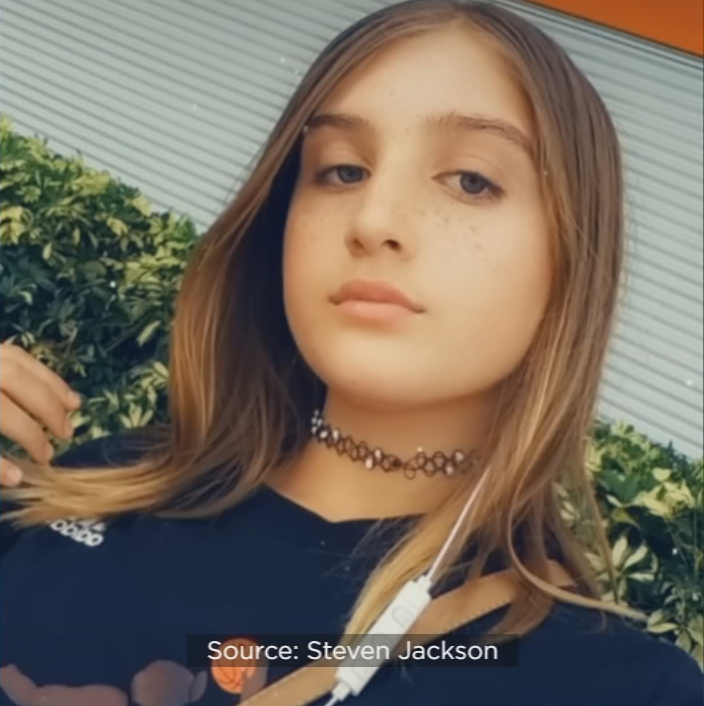
Fourteen-year-old Nicole Jackson was arrested on June 1, 2021, after what authorities described as an intense gun battle with Volusia County sheriff’s deputies.
This publication contends that the shooting evidence conflicts with that account and raises the probability that deputies endangered one another through a friendly crossfire incident. Something the sheriff's department is deeply embarrassed over - and wants to keep out of the public / media spotlight. In doing so, the sheriff encouraged a fourteen year-old girl to be overly prosecuted - to provide coverage for his deputies' misconduct - including the use of deadly force.
Jackson’s serious and nearly fatal gunshot injuries make an independent reconstruction of this police shooting incident especially important.
Following her arrest and Sheriff Mike Chitwood’s disputed account, Jackson became the subject of worldwide media coverage portraying two troubled children as modern-day versions of “Bonnie and Clyde” [5]. Contemporary Associated Press coverage [6].
At fifteen, Jackson accepted a plea deal carrying a twenty-year prison sentence. We contend that Judge Elizabeth Blackburn coerced Ms. Jackson into accepting the plea during a closed hearing behind locked courtroom doors. The court transcript - as discussed below - explains our concerns.
Her co-defendant, Travis O’Brien, was twelve at the time of the incident. He was prosecuted as a juvenile, while Jackson was prosecuted as an adult.
We question whether decisions made by the sheriff, prosecutors, defense counsel, and jail administrators reinforced an exaggerated shooting narrative at Jackson’s expense. The question is whether those decisions served justice, or protected rogue officials from accountability?
June 2021: the disputed gunfire account
The rifle evidence and the timing of deputies’ gunfire
Watch on YouTube [7] if playback is unavailable here.
This publication contends that the records and video footage invalidate two claims from Sheriff Chitwood’s June 1, 2021 media briefing (see video):
- The children fired numerous rounds from an AK-47 military-style rifle at deputies. (NOT TRUE)
- Deputies did not fire at the children until after sunset, when Jackson emerged from the garage pointing a shotgun toward them. (NOT TRUE)
Volusia Sheriff Investigator Cordell Lemay’s findings contradict Chitwood’s AK-47 account.
Lines 78–80 of Lemay’s report identified ONLY two fired shotgun shells and four spent .22-caliber casings—evidence of ONLY six shots being fired by the children. With no spent AK-47 ammunition being recovered - Lemay concluded that the AK-47 rifle had not been fired. Lemay's charging report, PDF page 3 [8].
In our reading, the FDLE report suggests that those six rounds were fired by the children to damage the home’s interior (light fixtures, etc) rather than to harm deputies. FDLE investigative report [9].
FDLE records describe O’Brien’s diabetic emergency (hyperglycemia) [10] with a blood-sugar reading of 443. During a subsequent hospital interview, while receiving treatment, he claimed to have fired the AK-47 at deputies and reloaded twice. FDLE report, pages 18–20 and 40 [9].
O’Brien’s medical condition at the time of the interview, together with the lack of recovered AK-47 casings, calls into question his claim that he fired the rifle.
The basis for Chitwood's AK-47 claim was O'Brien's hyperglycemic induced "confession". Without obtaining further verification - Chitwood immediately ran to the first available media microphone and camera and declared that Jackson and O'Brien were the new "Bonnie and Clyde [11]". That moniker quickly attached to the children - and went viral within world-wide media reports [12].
So why didn't Sheriff Chitwood retract his false statements about the AK-47 rifle fire when he became aware of Investigator Lemay's findings?
We suspect that preserving the false AK-47 narrative helped shield the deputies’ actions from examination. Correcting that account could have prompted a closer examination of another claim we contend was false: that deputies first fired at the children after sunset, when Jackson exited the garage holding the shotgun. Sheriff’s recorded briefing [7].
Watch Maxwell body-camera clip on YouTube [13] if playback is unavailable here.
Sgt. Don Maxwell’s body-camera footage, recorded PRIOR to sunset, contains approximately 32 audible gunshots by our count and a radio order from the sheriff's watch commander not to engage the children. Maxwell body-camera clip [13]. (see and listen to video)
If the recovered casings only account for six shots fired by the children, and deputies fired only after sunset as Chitwood claimed, who fired the approximately 32 shots heard in Maxwell’s daylight footage?
Did deputies disregard orders and put one another in the line of fire?
Chitwood said his deputies had surrounded the house. If they fired despite the watch commander’s order not to engage, did they shoot toward one another in a friendly fire incident [14]? Did the prospect of exposing their actions at trial contribute to pressure on Jackson to accept a plea?
A trial could have tested who fired, when and in which direction. Jackson’s plea ended that opportunity in her criminal case, but the questions remain relevant to civil review. Independent counsel should reconstruct the shooting, distinguish the suspected daylight crossfire from the shots that wounded Jackson, and determine whether excessive / unlawful force caused her injuries.
November 2022: was probable exploitation while in custody adequately investigated?
Our December 22, 2022 article [15] examined a November jail incident involving intimate photographs of fifteen-year-old Jackson and seventeen-year-old “Jane Doe.” Doe was being held on a charge of sexual misconduct with a child between twelve and fifteen. The jail found no qualifying abuse or harassment, and no criminal charges followed. We question whether those conclusions reflected a thorough investigation of probable exploitation?
Sheriff’s Detective Lance LaMee’s report recounts the jail’s findings without documenting independent interviews by him. Our reporting questioned the omission of Doe’s pending charge, whether child-protection referrals to the Florida Department of Children and Families (DCF) were addressed, and whether the jail met its obligations under the Prison Rape Elimination Act (PREA) [16]?
Did the sheriff’s office independently evaluate the evidence—or simply accept the jail’s conclusions? Denials of sexual contact did not resolve whether Jackson was exploited or whether staff provided adequate supervision. LaMee report [17].
Civil counsel should examine staff knowledge, housing and supervision decisions, and the investigation itself for failures to protect Jackson.
January 2023: was jail discipline used to block new counsel?
Was the January 14 disciplinary incident contrived by jail staff —and then used to cut Jackson off from the people who could help her secure another attorney? Our September 2026 reporting [3] asked corrections officials to explain the disciplinary report’s chronology, and the discipline’s effect on her access to new defense counsel. We received no clarification.
The sequence matters. On January 5, Jackson rejected a twenty-year plea offer, unsuccessfully asked to replace her lawyers, complaining that they were pressuring her to accept the plea deal. Nine days later came the alleged jail incident. WFTV: Jackson rejects twenty-year plea deal, January 5, 2023 [18].

In disciplinary report 230004787, Officer P. Hall alleged that Jackson threatened to kill staff and planned to replace Avallone by accusing him of looking at her sexually. Officer T. Joyal supplied a similar account four days later. Jackson denied the allegations. Our reporting identified no additional criminal charges over the threats, but a January 19 disciplinary hearing resulted in Jackson being housed for thirty days within the Behavior Management Unit (BMU). Disciplinary report and supplement [20].
Our reading places the request for the disciplinary report tracking-number more than three hours before the occurrence of the alleged disciplinary incident. To emphasize the significance of this - imagine if in November 1963 - it was discovered that the U.S. Secret Service had made documented arrangements to ship President Kennedy's body back to Washington D.C. - three and a half hours PRIOR to his assassination.
The tracking-number request identified by this publication precedes the alleged incident by 3 hours, 33 minutes.
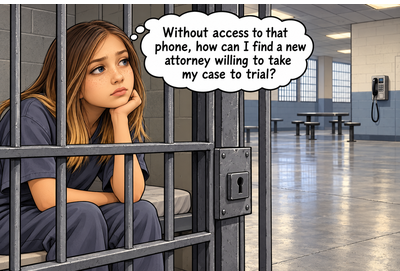
Did jail officials—or anyone directing them—weaponize disciplinary segregation to prevent Jackson from changing attorneys and steer her toward the plea?
We suspect the discipline was used to isolate Jackson at a critical point: after she had rejected the plea, and was still seeking new lawyers, but before the January 27 closed hearing, where we allege - Judge Blackburn coerced Jackson into accepting the plea deal.
Segregation could have hindered Jackson’s efforts to secure a private attorney willing to take her case to trial. On page 56, lines 9–17, she complained that staff denied her phone and tablet time, explaining that phone access was unavailable around the clock. Court transcript, page 56, lines 9–17 [21].
Officer Joyal’s later history adds reason to examine her account independently. She was reportedly terminated and arrested on July 6, 2026, on a perjury charge arising from an unrelated official investigation. Joyal arrest record [22].
During the January 27 closed hearing - on page 56, lines 18–19 of the transcript, Avallone acknowledged that Jackson’s “handling” had changed during the preceding two weeks, suggesting he was following changes in her jail treatment. Did that awareness extend to the disciplinary report’s allegation that she planned to accuse him of looking at her sexually? If so, did it affect his judgment or advocacy on her behalf? Court transcript, page 56, lines 18–19 [21].
A backdrop of other alleged inmate-rights violations
In December 2022, the county moved to dismiss Corrections Director Mark Flowers - firing him on January 6, 2023—eight days before Jackson’s reported disciplinary incident. His attorney described the dismissal as retaliatory. December dismissal notice [23]; January termination [24]. WFTV reported allegations of inmate discipline without due process and restrictions on inmate communications. WFTV reporting [25].
Flowers offered a different account: he alleged that he was trying to stop inmate abuse and that county superiors suppressed his complaints and retaliated against him. News-Journal: Flowers’s whistleblower allegations [26]; Flowers’s lawsuit [27]. He sued the county, which later approved its share of a $750,000 settlement. News-Journal: settlement approval [28].
Our concern is whether those alleged practices continued after Flowers’s departure and affected Jackson’s access to effective legal counsel.
Avallone’s sheriff’s-office ties and his duty to Jackson
Judicial ambitions and the pursuit of Chitwood’s endorsement

Public confidence in justice depends on addressing actual conflicts and reasonable concerns about divided loyalty.
Assistant Public Defender Larry Avallone served as a Volusia sheriff’s deputy from 1994 to 2003, later representing Jackson on charges that she attempted to murder deputies from that same agency. Avallone’s biography [29]. At the January 27, 2023 hearing, Judge Blackburn described Jackson’s lawyers as “the persons I have appointed to you.” Transcript, page 15, lines 11–16 [21].
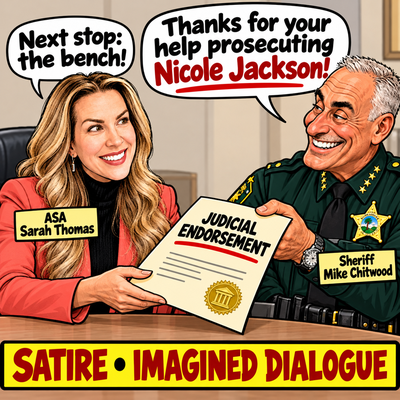
Avallone’s former employment alone does not establish a conflict. But his refusal to challenge the sheriff’s false accounts raises a central question: did his representation serve Jackson’s due-process rights or Chitwood’s political interests? We also question whether the prospect of securing Chitwood’s endorsement for a future judicial campaign influenced his handling of Jackson’s defense.
Avallone later sought judicial office but withdrew after we notified him of our intention to publish our June 2026 article questioning his ethical fitness for judicial office [30].
Chitwood did endorse Sarah Thomas, the lead prosecutor in Jackson’s case. His glowing political endorsement [31], issued after Jackson’s plea and conviction, specifically praised her handling of that prosecution. Neither Thomas nor Avallone ultimately secured a judicial seat.
Two cases, different responses to prejudicial publicity
What explains the difference in Avallone’s advocacy?
In Charles Leon Ivy’s unrelated 2023 murder and arson case, Avallone sought an order against prejudicial publicity, arguing that Daytona Beach Police Chief Jakari Young’s comments could influence prospective jurors. Ivy motion [32].
Young described the alleged crimes as the "most horrendous and horrific crimes" he had witnessed—an opinion about their severity. Our objection to Chitwood’s account concerns factual claims we contend the evidence contradicts, including the AK-47 claim discussed above.
During the January 27, 2023 hearing, Jackson complained that her lawyers had not countered Chitwood’s damaging statements, citing allegations about a fire and puppies rather than the AK-47. Avallone acknowledged inaccurate coverage but said correcting it was not his role. Court transcript, pages 48–50 [33].
Why seek court intervention for Ivy but not Jackson? Did a defensible strategy explain the difference, or did Avallone simply protect his former agency at his client’s expense?
January 27, 2023: publicity and the closed hearing
Judge Blackburn closed the hearing to the public, citing extraordinary publicity, fair-trial rights and confidential attorney communications. Court transcript, pages 7–10 [21]. Blackburn later criticized supporters’ statements and online posts as threats to Jackson's ability to obtain a fair trial. Court transcript, page 33, lines 5–16 [34].
Jackson’s supporters learned of her plight through the very publicity we contend Chitwood fueled with false accounts shared through news outlets and his government-sponsored social media. Why criticize the supporters’ responses without equally examining Chitwood’s role in generating that attention? We suspect he encouraged a public presumption of guilt that protected his account and his deputies’ actions from examination.
Public condemnation on the sheriff’s social media cannot substitute for a fair trial. Our concern about the Sixth Amendment’s guarantee of a public trial [35] is whether official publicity, counsel’s failure to challenge inaccuracies and the closed hearing undermined Jackson’s opportunity to publicly contest the allegations lodged against her.
Did the closed hearing protect Jackson—or pressure her?
Did Judge Blackburn cross the line from examining Jackson’s complaints about trial counsel to coercing her into accepting a plea? We also question whether the transcript was sealed to conceal that alleged coercion. Florida judicial ethics guidance [36].
Judicial independence and Chitwood’s attacks on judges
Could concern about Chitwood’s public criticism have influenced Blackburn’s handling of Jackson’s case—including the prolonged wait for a ruling on her post-conviction motion? Three disputes illustrate his willingness to challenge judges who question his officers or issue rulings he opposes.
In February 2012, while serving as Daytona Beach police chief, Chitwood sharply criticized Circuit Judge Joseph G. Will for calling two of his officers liars. In a February 21 letter on city letterhead, he accused Will of personal bias and distorting the facts, questioning the judge’s fairness and impartiality. Chitwood’s February 21, 2012 letter [37].
In September 2019, FlaglerLive [38] editor Pierre Tristam reported that Chitwood asked Chief Judge Raul Zambrano to reverse Judge Michael Hutcheson’s appeal-bond ruling for criminal defendant Mark Fugler. Zambrano defended the ruling; Tristam characterized Chitwood’s intervention as an attack on judicial independence. FlaglerLive: “Sheriff Mike Chitwood Smears Our Judges” [39].
In November 2025, Chitwood attacked Judge A. Kathleen McNeilly’s forty-five-day jail sentence for Jorge Rivera following a confrontation with a school resource deputy. VolusiaExposed’s McNeilly editorial [40]. He also used social media to urge action at the ballot box, saying he would ask voters to remove McNeilly when she next appeared on the ballot in 2028. ClickOrlando: Chitwood urges voters to remove McNeilly [41].
These episodes raise a broader concern: whether judges face pressure to satisfy the sheriff rather than exercise independent judgment. Judges must decide cases on the law and the evidence, free from such pressures, and they should never become an agent of the sheriff, by coercing a young girl into taking a plea deal.
Judicial concerns before the plea, silence afterward
Jackson’s post-conviction challenge brings the article’s earlier questions back to court: did her representation protect her rights, and was her plea valid?
On February 26, 2025, attorney Dan Ripley filed Jackson’s Rule 3.850 motion challenging Avallone’s effectiveness as trial counsel and the validity of her plea. It alleges inadequate attention to her mental health, comprehension and distress, along with incorrect sentencing and youthful-offender advice. part A [42]; part B, pages 35–42 [43].
Complete filing: part A [42]; part B [43]; part C [44]; part D [45]; part E [46].
On March 11, 2026, Ripley reported 378 days without an order and requested an explanation. Notice of inquiry [47]. As of October 23, 2026, 604 days—nearly twenty months—had elapsed since filing.
Why did protecting Jackson’s rights warrant closing the courtroom before her plea, yet her claim that counsel failed to protect those rights has been met with such prolonged judicial silence? The contrast between Blackburn’s stated concern before the plea and the absence of a ruling to Jackson's post conviction 3.850 motion demands an explanation.
Jackson’s due-process interests did not end when she accepted a twenty-year sentence. Her motion asks whether Avallone provided effective assistance and whether her plea can stand. Those questions require timely judicial consideration, not an indefinite wait while she remains imprisoned.
Justice delayed is justice denied. We question whether this silence has protected government officials from accountability at Jackson’s expense. That concern for her rights should carry through to a timely ruling.
In February 2025 - the Clerk of Court inadvertently made the sealed January 27, 2023 hearing transcript and Rule 3.850 motion publicly available, then quickly withdrew that access.
Absent these documents (transcript / 3.850 motion) being available for review, this publication could not present our belief that Judge Blackburn engaged in judicial misconduct - with these documents - the proof of judicial misconduct is overwhelming.
We have provided links to these secretive documents, so our readers can examine the records for themselves. For background on freedom of the press and prior restraint, see (New York Times Co. v. United States 403 U.S. 713, 1971) [48].
Should Blackburn step aside—and could delay defeat civil claims?
Should Judge Blackburn recuse herself from reviewing Jackson’s Rule 3.850 motion? Her handling of the closed plea hearing is central to this publication’s concerns. Can she impartially assess Jackson’s challenge if doing so requires evaluating her own conduct? Civil counsel should examine whether the record gives reasonable grounds to question her impartiality, using Florida judicial ethics guidance [36] as the framework for that assessment.
Could the delay be intended to let civil filing deadlines expire before the court considers Jackson’s 3.850 allegations? We question whether postponement could shield officials from civil scrutiny by allowing time to pursue civil claims to run out. Counsel should examine the applicable deadlines, the reasons for the delay and whether those responsible knew it could undermine Jackson’s ability to seek civil relief.
Thoughts for independent civil counsel
Independent civil counsel should speak with Jackson and Ripley, examine the underlying records and assess four areas of potential harm:
- The shooting: Was the force reasonable given the threat when deputies fired? Did disregarded commands, crossfire, or failures in policy, training or supervision contribute to Jackson’s injuries?
- Safety in custody: Did jail staff knowledge, housing, supervision or investigative failures expose Jackson to exploitation or other harm?
- Publicity and the plea: What did officials know about inaccuracies, and how did publicity, defense counsel’s response, or lack thereof, and the closed hearing affect Jackson’s defense and plea?
- Replacement counsel: What explains the disciplinary report’s conflicting times? Did actual communication restrictions prevent Jackson from securing another attorney prior to the plea and sentencing hearing?
Relevant evidence includes synchronized recordings, radio traffic, ballistics, medical records, agency policies, counsel-assignment records, disciplinary audits, call and visitation logs, housing assessments, and charging and plea communications.
Ripley’s 3.850 motion challenges Jackson’s legal representation and plea. A separate civil review should assess whether misconduct caused harm for which officials or government entities could be held liable, and whether any privileges or immunities limit those claims. Official-statement privilege [49]; Claims against public agencies [50].
Civil counsel should also determine the filing deadlines and any applicable tolling provisions for each potential claim. Florida tolling provisions [51]; Florida limitations provisions [52].
Supporting Nicole Jackson’s pursuit of justice
 [53]
A September 22, 2022 Daytona Beach News-Journal article [55] recounts how three strangers became advocates for Nicole Jackson: Matt Shortt, a former paralegal; Robert Kleinmark, a retired hospital employee; and Jean Bailey, a local social advocate, who operates a non-profit advocate program - advocating for others, inc.
None of the three knew Jackson before her arrest, or knew one another before the news coverage and Chitwood’s social media blitz brought Jackson's case to their attention. Their shared concern for her safety, and right to due process brought them together.
The trio have stayed in contact with Jackson throughout her imprisonment - and secured Jackson her current attorney Dan Ripley, who specializes in post-conviction reviews.
In fairness to the principles
In fairness to Mr. Avallone, Sheriff Chitwood, Judge Blackburn, and Assistant State Attorney Sarah Thomas - this publication provide to them a copy of this article via email [56] - and invited them to respond to our concerns. As of the publication of this article - no responses were received.