Dogs Destroyed Before Charges Were Filed: Police Evidence Handling Deserves Additional Scrutiny
An eight-year-old boy killed in a dog attack. Seven months to announce charges. Dogs euthanized within weeks. A police interview recording that cannot be found. Volusia’s handling of evidence deserves a better accounting.
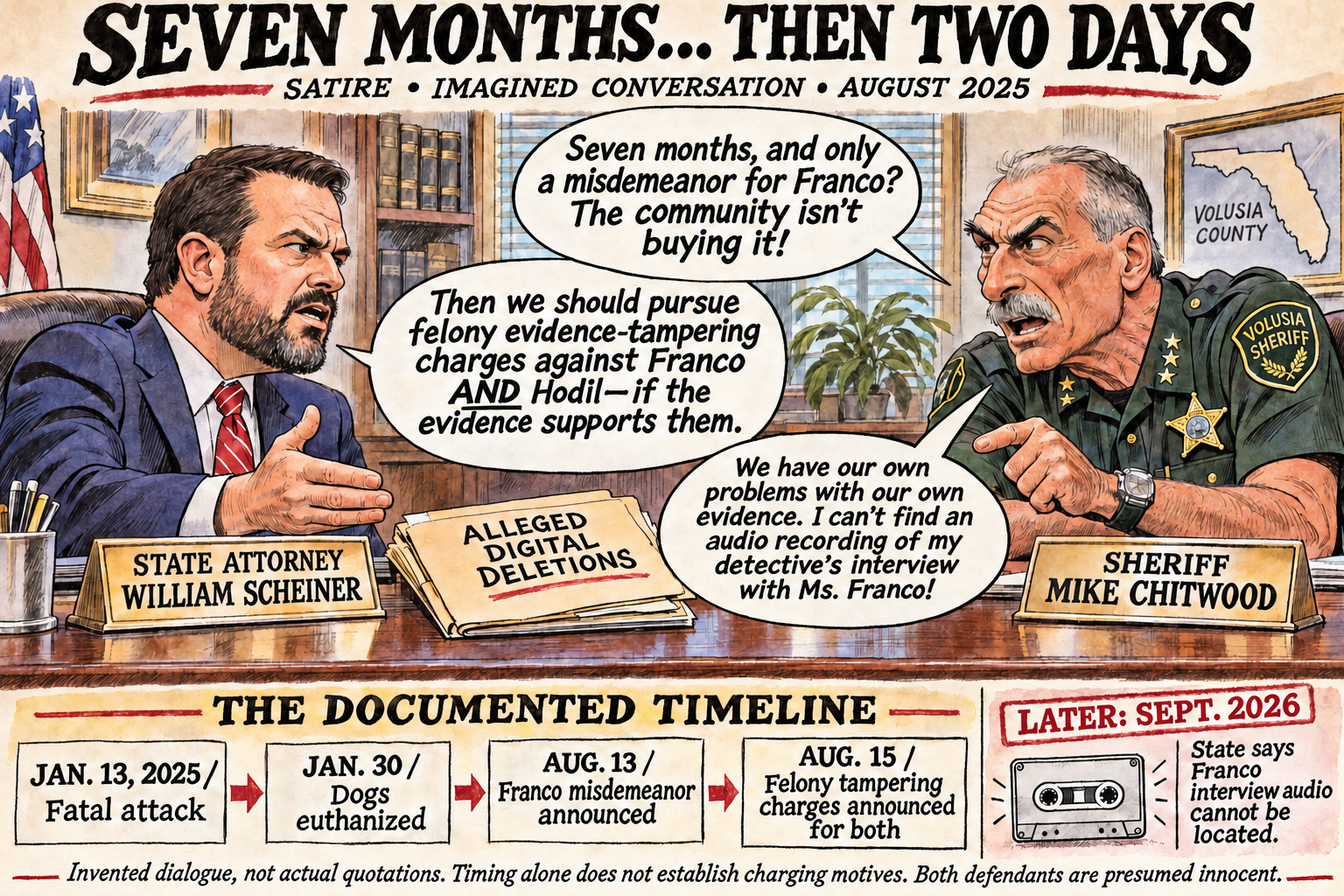
VOLUSIA COUNTY, Fla. — Amanda Franco and Brandy Hodil both face felony charges for allegedly deleting evidence during the investigation of 8-year-old Michael Millett’s death. Yet prosecutors acknowledge that a police recording of Franco’s interview cannot be located, and county officials euthanized the dogs involved months before charges were announced.
The contrast raises questions about the seven-month investigation, the sequence of charging decisions and the defense’s opportunity to assess potentially exculpatory evidence from the dogs or the missing interview recording.
Michael died January 13, 2025, after stopping to pet a dog while riding his bicycle with a friend, according to News 6. His family supported euthanizing the dogs. Respect for their loss and pursuit of justice is compatible with asking whether officials preserved the evidence needed for a fair prosecution.
Seven months of investigation, two days between announcements
Sheriff Mike Chitwood sought charges almost immediately. WFTV reported on January 15 that he wanted to pursue a felony negligent-homicide charge against Franco. The same report quoted Animal Services Director Angela Miedema describing the dogs as evidence. That description matters: By the time criminal charges were announced, the dogs had been destroyed for months.
Prosecutors attributed the seven-month delay to evidence gathering, laboratory testing and legal research. July reporting also explained that State Attorney William Scheiner’s office took over because an employee of the local prosecutor’s office was related to a dog owner. WESH later reported that prosecutors concluded they could not prove the culpable negligence required for manslaughter beyond a reasonable doubt.
On August 13, 2025, authorities announced the filing of a second-degree misdemeanor against Franco arising from the death. Scheiner and Chitwood both described the misdemeanor outcome as inadequate. In the video of his remarks, Chitwood expresses frustration, thanks prosecutors for their research and urges legislative change.
Two days later, an official update announced third-degree felony tampering charges against both women. It reported Hodil’s arrest the previous night and attributed the charges to investigation and coordination with prosecutors. Authorities alleged Franco deleted a Facebook account containing relevant messages and Hodil deleted messages about the dogs being loose.
The two-day interval warrants a direct question: Were felony tampering charges already being developed, or did the misdemeanor decision and public reaction give their pursuit new political urgency?
A missing police interview recording raises questions about the investigation
The State’s September 1, 2026, response to Franco’s motion to compel documents a separate evidence problem. Former Volusia Sheriff’s Office Detective Devon Sawicki testified at an August 10 deposition that she recorded Franco on the night of the attack using an agency-issued iPhone. Her supplemental report did not mention a recording, and the prosecutor said she knew nothing of it before the deposition.
The audio “cannot be located, likely because it was never uploaded,” the filing states. Body-camera footage exists, but distance and an interruption prevent the full conversation from being heard. Prosecutors asserted that they had provided the discovery materials in their possession and asked the court to deny the motion.
The irony is substantial: The government accuses Franco of making digital evidence unavailable while acknowledging that its own recording of her interview is unavailable. Without that audio, the defense cannot directly compare her recorded account with later testimony or the prosecution’s theory.
The missing recording also calls into question the investigation’s quality and thoroughness. How was it documented, stored and tracked? Why did the prosecutor learn of it only during a deposition more than a year later? The filing establishes neither deliberate police deletion nor what the recording would prove. Criminal tampering requires an intent to impair evidence’s truthfulness or availability; a missing recording alone does not establish that intent. It does demand an explanation of how evidence was preserved and what efforts were made to recover the missing recording.
The dogs were destroyed before defense counsel’s documented appearances
The county announced that the dogs were euthanized on January 30, 2025—17 days after the attack. It said the owner had not appealed the dogs’ destruction during the waiting period and announced plans to send forensic material to Harvard’s Canine Brain Research Group.
Formal charging documents for Franco and Hodil were filed August 21, 2025, following the earlier announcements. Criminal defense attorney - Julie M. Clarke entered her appearance for Franco on August 25. Hodil’s September 11 arraignment record documents the appointment of a public defender.
By then, the dogs had been dead for roughly seven months, making examination of the living animals impossible. The filings do not establish when either woman first consulted counsel or whether Hodil’s appointment began at an earlier hearing. The court records nevertheless document defense counsel’s involvement only months after the dogs were destroyed.
What procedures governed destruction and preservation?
A February 19 internal inquiry records Volusia County Animal Control office manager Shari Williams questioning why a “confiscation for destruction” form had not been used to memorialize the dogs’ destruction. Field supervisor Jennifer Meister reportedly was unfamiliar with that particular form. The inquiry did not determine whether officials followed proper euthanasia procedures or preserved evidence for a criminal prosecution.
Florida’s statutory framework directed destruction after specified procedures and prohibited it during a pending written appeal. Officials must explain how they satisfied those requirements while preserving evidence for the foreseeable criminal prosecutions.
Had a firearm caused Michael’s death, the public would expect it to be retained for examination. Living animals present different obligations, but preserving them could have allowed qualified defense experts to assess their behavior. Defense counsel could also have asked jurors to observe the dogs, subject to the judge’s approval based on safety and relevance.
A detailed accounting is needed
Investigators, prosecutors and county officials should provide a documented account of:
- Charging decisions: When testing ended, when suspected deletions were discovered and when felony charges were first sought.
- The interview: Recording and upload procedures, device records, recovery efforts and the emails referenced in the State’s response.
- The dogs: Euthanasia approvals, examinations, retained specimens, custody and disposal records, research transfers and defense-access requests.
Michael’s family and the defendants deserve a case tested against reliable evidence. The government’s handling of evidence—what it preserved, destroyed or lost—deserves the same scrutiny as its allegations against Ms. Franco and Ms. Hodil.
Both defendants are presumed innocent. September 2026 reporting placed their trial in early 2027.
VolusiaExposed.Com contacted the principal parties involved in the prosecution through this linked email and invited them to preview the article and respond. None of those contacted had responded by the time this article was published.